Gateway Project Advisory Meeting: Celebrating Progress and Charting the Future
Aging-ResearchResearchPublished on: Dec 10, 2025
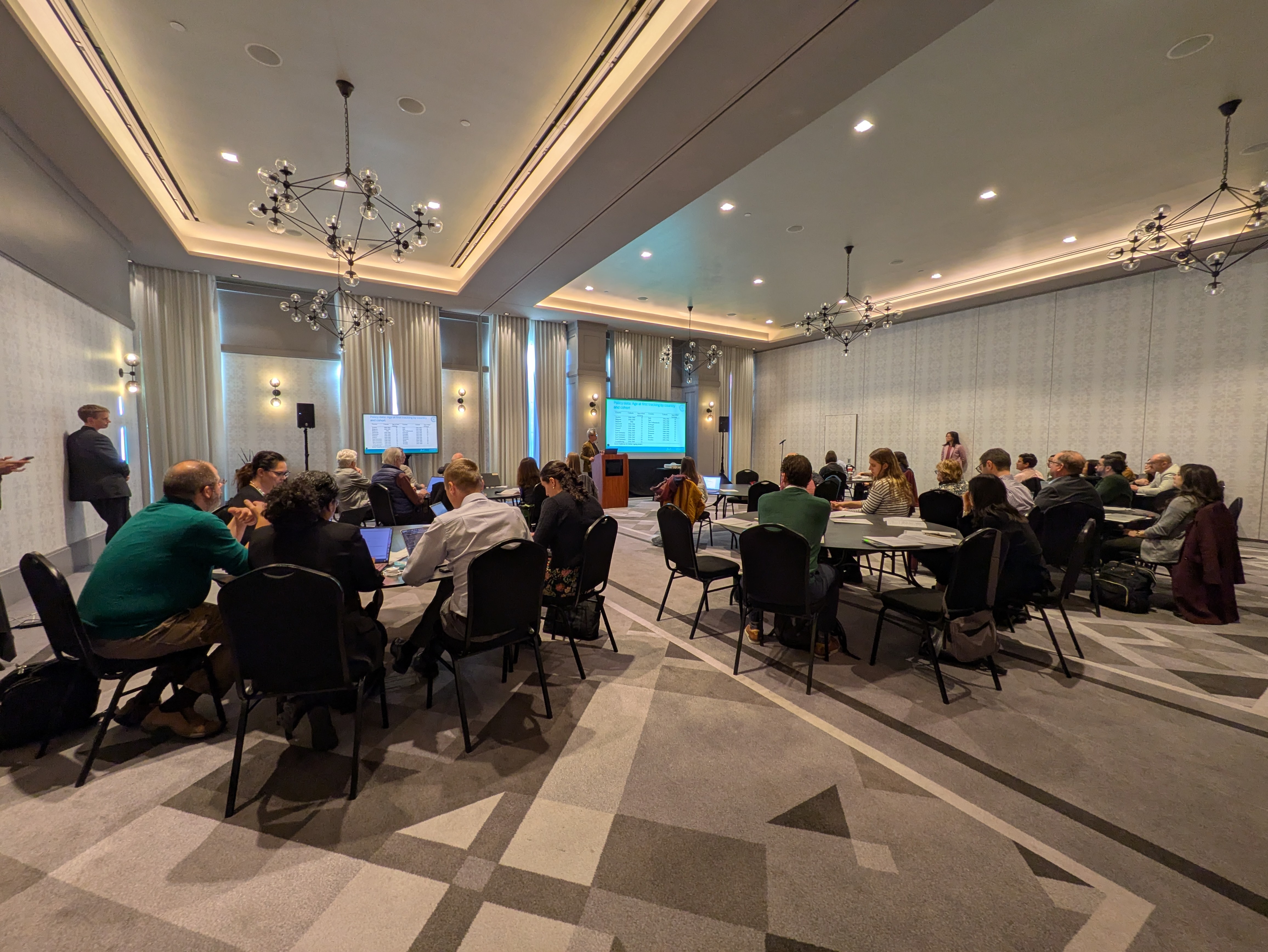
The Gateway to Global Aging Data team gathered in Bethesda, MD from November 17-18, 2025, for our annual project advisory meeting. The meeting was a chance to reflect on a year of achievements and chart the Gateway’s course forward. Joining Gateway researchers and staff were project advisors and leaders, as well as project officers from the National Institute on Aging (NIA).
Project MPI Jinkook Lee (University of Southern California, USC) and NIA Deputy Director Richard Hodes opened the meeting, welcoming and thanking everyone who has made the Gateway’s work possible over the past year. Drystan Phillips (USC) then provided an overview of the Gateway's recent accomplishments, establishing the foundation for what followed: a series of presentations that not only described the Gateway’s outputs, but also demonstrated their significant impact on aging research.
To showcase some of this impact, Emma Nichols (USC) and David Flood (University of Michigan, UM) demonstrated how Gateway's harmonized data is enabling novel research across disciplinary divides and datasets, unlocking new research questions and cross-national insights that would otherwise remain impossible to explore.
The HCAP Team: Advancing Cognitive Assessment Harmonization
Building on this foundation, Alden Gross (Johns Hopkins University, JHU) shared the HCAP team's impressive progress across multiple fronts. The team has made significant strides in pre-statistical harmonization, statistical harmonization, imputation and standardization, and algorithmic classification of dementia and mild cognitive impairment. Beyond the technical work, their capacity building activities are ensuring that researchers worldwide can make the most of these innovations.
The team's presentations on research applications demonstrated the power of this harmonized data. Olivia Atherton (University of California, Riverside) presented “Lifespan exposures to rural-urban conditions and later-life cognitive function,” while Sneha Mani (JHU) shared insights from her recently published paper, “The intersection of country, gender, and occupation using MAIDHA.” These presentations illustrated how harmonized cognitive data can illuminate complex relationships between life course exposures and cognitive outcomes.
Looking ahead, Gross and Nichols previewed exciting next steps, including longitudinal harmonization of HCAP data that will allow scores from all HCAPs to be scaled to the first HRS-HCAP interview — a development that promises to further expand the scope of possible cross-national cognitive aging research.
Policy Team: From Data Collection to Cross-State Insights
The Gateway policy team's presentation conveyed both the breadth of their current work and their plans for expansion. Currently covering retirement, long-term care (LTC), and education policies, the team is preparing to extend their reach into health system and caregiving policies.
Since mid-2024, the Gateway policy team has completed 60+ new policy documents, bringing their total to 165. They also launched the Education policy explorer for U.S. compulsory schooling policy, continued developing harmonized measures across all policy series, and held several successful dissemination and capacity-building events.
Maya Franz-Myers (USC), Heber Davila (Università Ca' Foscari Venezia), and David Knapp (USC) demonstrated this impact by presenting research on differences in access to public LTC across U.S. states. Their work showed how newly developed harmonized LTC policy measures make novel cross-state comparisons possible, revealing patterns that would remain hidden without such standardization. Clémence Kieny and Mauricio Avendano (University of Lausanne) then presented research that leveraged novel educational tracking policy data to investigate whether postponed tracking mitigates the socioeconomic gradient usually seen in late-life cognitive function.
Courtney Harold Van Houtven (Duke) and David Flood (UM) previewed the two new arenas for forthcoming Gateway policy research: caregiving and health system policies. Caregiving policy collection will build off the Gateway’s existing LTC policy infrastructure, adding data on both formal and informal caregiving policies in all U.S. states. Health systems policy collection will entail documenting how health systems differ across countries, focusing on identifying key dimensions of health systems that alter individual health choices, such as frequency and duration of healthcare visits.
Environmental Exposome: Expanding Our Understanding of Place-Based Exposures
Sara Adar (UM) presented the Gateway's Environmental Exposome initiative, which has also expanded its scope over the past year. The exposome team has moved beyond their initial focus on air pollution and natural space elements (e.g., greenspace, blue space, and light at night) to incorporate weather-related exposures, including temperature, heat index, and precipitation. By linking all these harmonized measures to numerous HRS-INS studies, the team has created infrastructure that supports both intra-country and cross-country analyses.
The research presentations that followed demonstrated this infrastructure at work. Boya Zhang (Harvard) and Nia Clements (UM) presented papers leveraging cross-country analyses of air pollution exposures, while Carina Gronlund (UM) explored the relationship between extreme heat and cognition across the U.S. and England. These studies exemplify how harmonized environmental data can reveal how relationships between exposures and health outcomes compare across and between different national contexts.
Michael Brauer (University of British Columbia) and Kayleigh Keller (Colorado State University) concluded the exposome presentations by highlighting future directions, including measures to gauge pesticide exposures and the use of mixture modeling to characterize the external exposome more comprehensively.
Looking Ahead
Across all presentations, one priority remained constant: ensuring that Gateway's work and methods are not only technically robust, but also accessible and practical for researchers worldwide. Our project advisors were instrumental in refining this vision. Their questions pushed us to think critically about methodological choices, their suggestions opened up new research avenues, and their feedback on dissemination strategies will help us reach broader audiences in the next project cycle. For this and for all their contributions to the Gateway, we would like to extend our deep gratitude to our project advisors, our colleagues and officers at the NIH/NIA, and the other advisory meeting participants who are helping ensure that the Gateway remains at the forefront of aging research.
About the author:
- Dr. Ava Bindas is a Communications Analyst at the University of Southern California.